NOCTILUCA
Acquisition · Live
Bioluminescence Observatory · Est. MMXXIV

Cold fire in the lightless deep.

A field study of the creatures that manufacture their own light — where sunlight cannot reach, and life refuses the dark.

0 Specimens catalogued
0m Max descent
0nm Peak emission
N 24°52' W 079°14' — STATION VII —
I

In the midnight zone, ninety percent of organisms make light. Not reflected. Not borrowed. Produced — by a cold chemistry older than the first eye.

The light they make is blue because blue travels farthest in salt water. It is cold because the reaction loses almost nothing to heat. It is silent, weightless, and unfathomably common — the most widespread communication channel on the planet.

We descend to read it. This catalogue is not a trophy case. It is a field notebook written in photons: the vocabulary of animals that speak by glowing, by flashing, by pouring themselves out into the dark and trusting something will see.

→ cold light, in three compounds luciferin + O2  ⟶  oxyluciferin +
II

Four layers of dark, four vocabularies of light.

  1. 01
    200 m

    Mesopelagic

    — the twilight zone —

    The last blue whisper of the sun. Here, counter-illumination begins: bellies lit to match the faint ceiling above, erasing silhouettes from the predators below.

  2. 02
    1,000 m

    Bathypelagic

    — the midnight zone —

    Perpetual night. Light is now purely a language — burglar alarms, mate-search beacons, lures. Nearly every animal here glows.

  3. 03
    4,000 m

    Abyssopelagic

    — the abyss —

    Pressure is four hundred atmospheres. Food is ash from above. The rare flash you see is almost certainly the last thing something ever sees.

  4. 04
    6,000 m+

    Hadal

    — the trenches —

    Named for Hades. Trenches deeper than the Grand Canyon is tall. Yet even here, in the crushing geometry of the plates, something is quietly making light.

III

Four animals, four dialects.

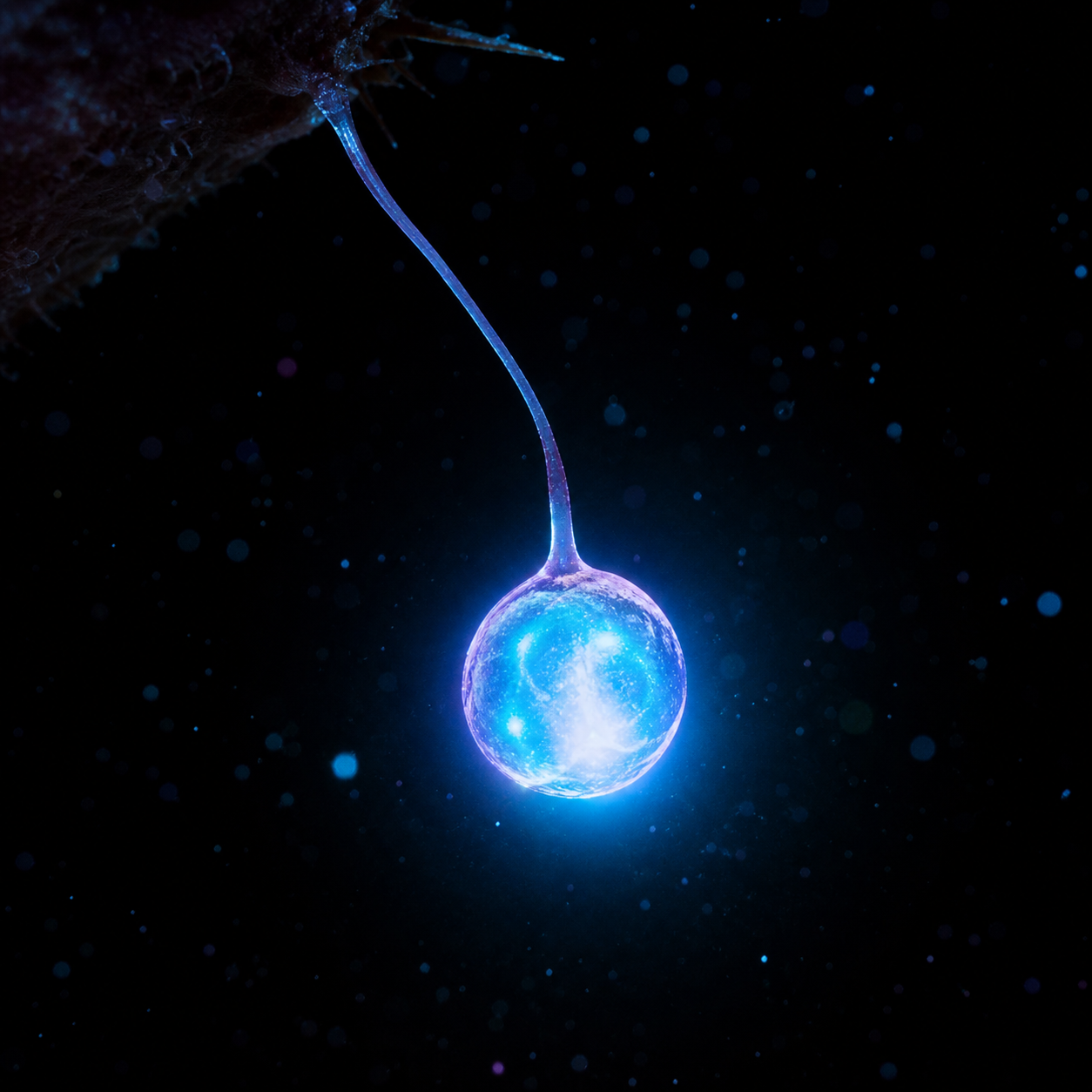
A glowing bioluminescent anglerfish lure orb dangling in darkness
PL. 01
N° 01 Melanocetus johnsonii

The Hairy Anglerfish

Habitat · 1,000–4,000 m · Bathypelagic

A lure on a rod of her own dorsal spine. The orb at its tip is a colony of luminous bacteria she feeds with her blood — a lantern she carries in her mouth for life. She flashes it in the dark and waits for the foolish and the hungry. The tiny males, once they find her, fuse to her body and are slowly absorbed until only gonads remain. A love story, of sorts.

MechanismBacterial symbiosis
Wavelength488 nm · blue-green
FunctionPrey lure
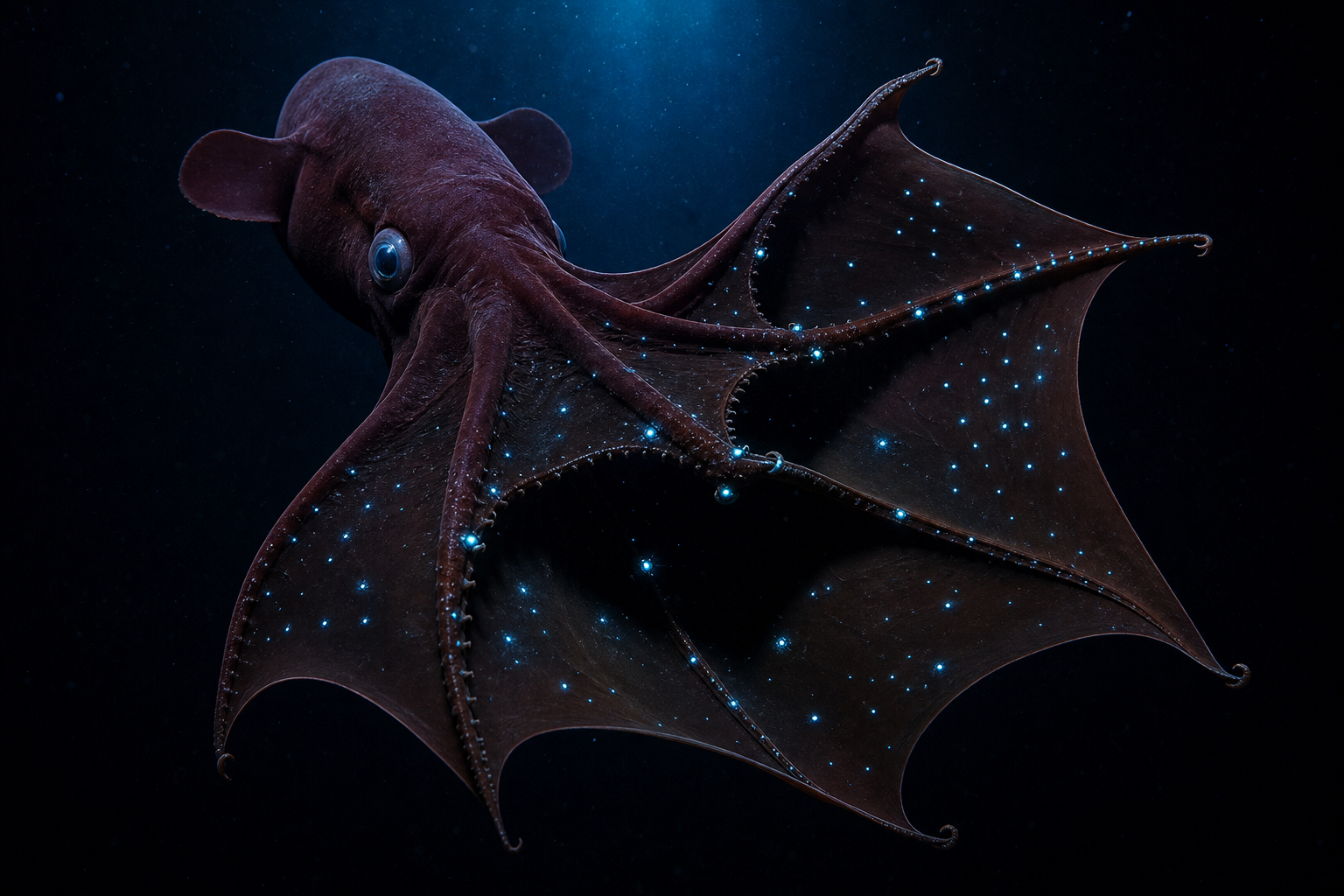
A vampire squid with arms spread like a cape, photophores glowing
PL. 02
N° 02 Vampyroteuthis infernalis

The Vampire Squid

Habitat · 600–1,200 m · Oxygen minimum zone

Named “the vampire squid from hell,” though it eats only marine snow. Threatened, it does not bite or flee — it everts its webbed arms into a defensive crown of spines, then goes dark. Along its arms, a hundred photophores ignite in a confused, scattering glow, a smokescreen made of light itself. A pacifist that weaponizes beauty.

MechanismIntrinsic photophores
Wavelength470–500 nm
FunctionDefense · confusion
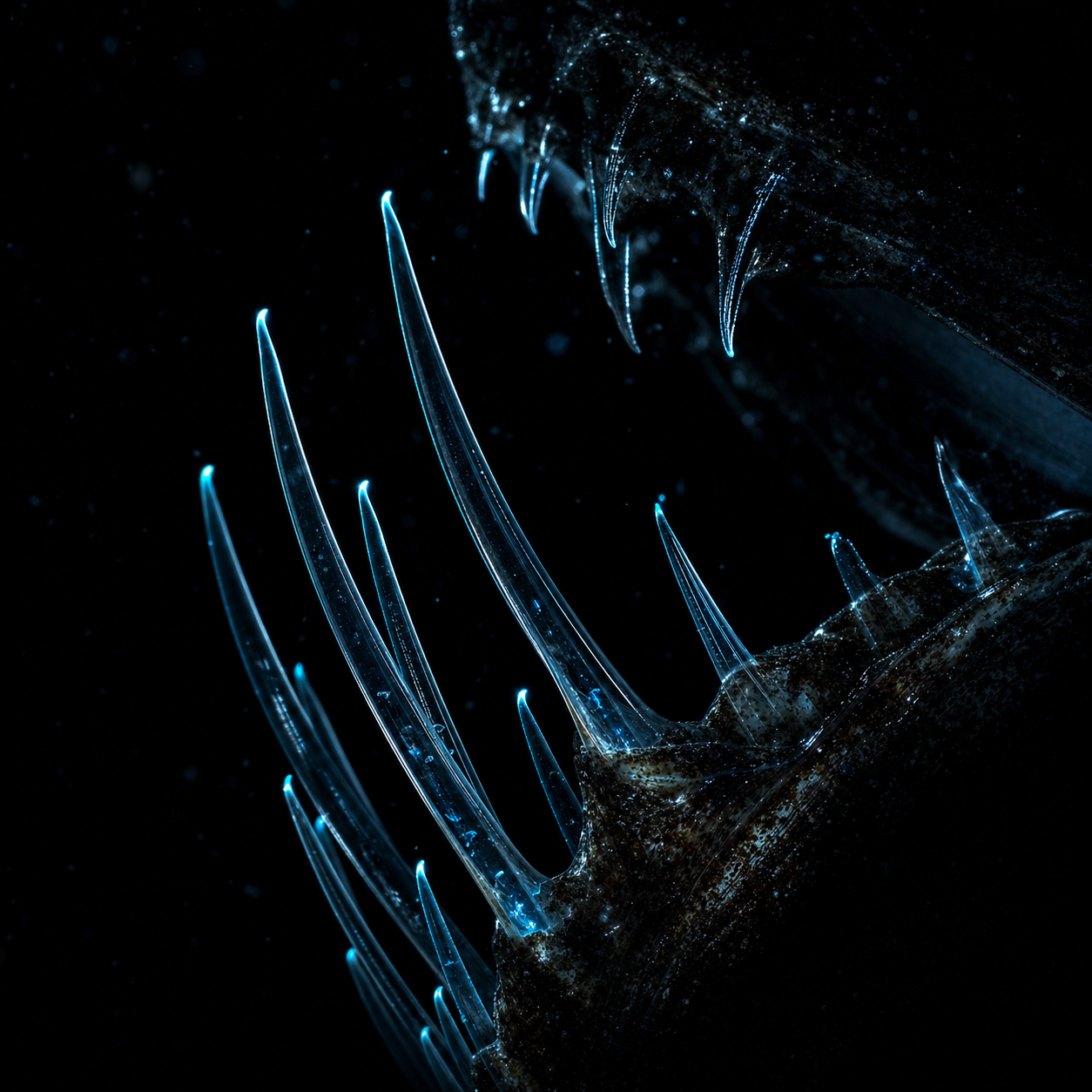
Needle-like transparent dragonfish teeth faintly outlined by bioluminescent glow
PL. 03
N° 03 Aristostomias scintillans

The Deep-Sea Dragonfish

Habitat · 500–2,500 m · Mesopelagic–Bathy

A fish that sees in a colour no other animal can. Below each eye, a pouch emits red light from a custom-built chlorophyll-derived pigment — its own private headlamp. Its prey, evolved only to see blue, are lit by a beam they cannot perceive. It hunts with a wavelength that does not, to the rest of the deep, exist. Invisible sniper of the black.

MechanismRed-emitting photophore
Wavelength~705 nm · far red
FunctionCovert hunting
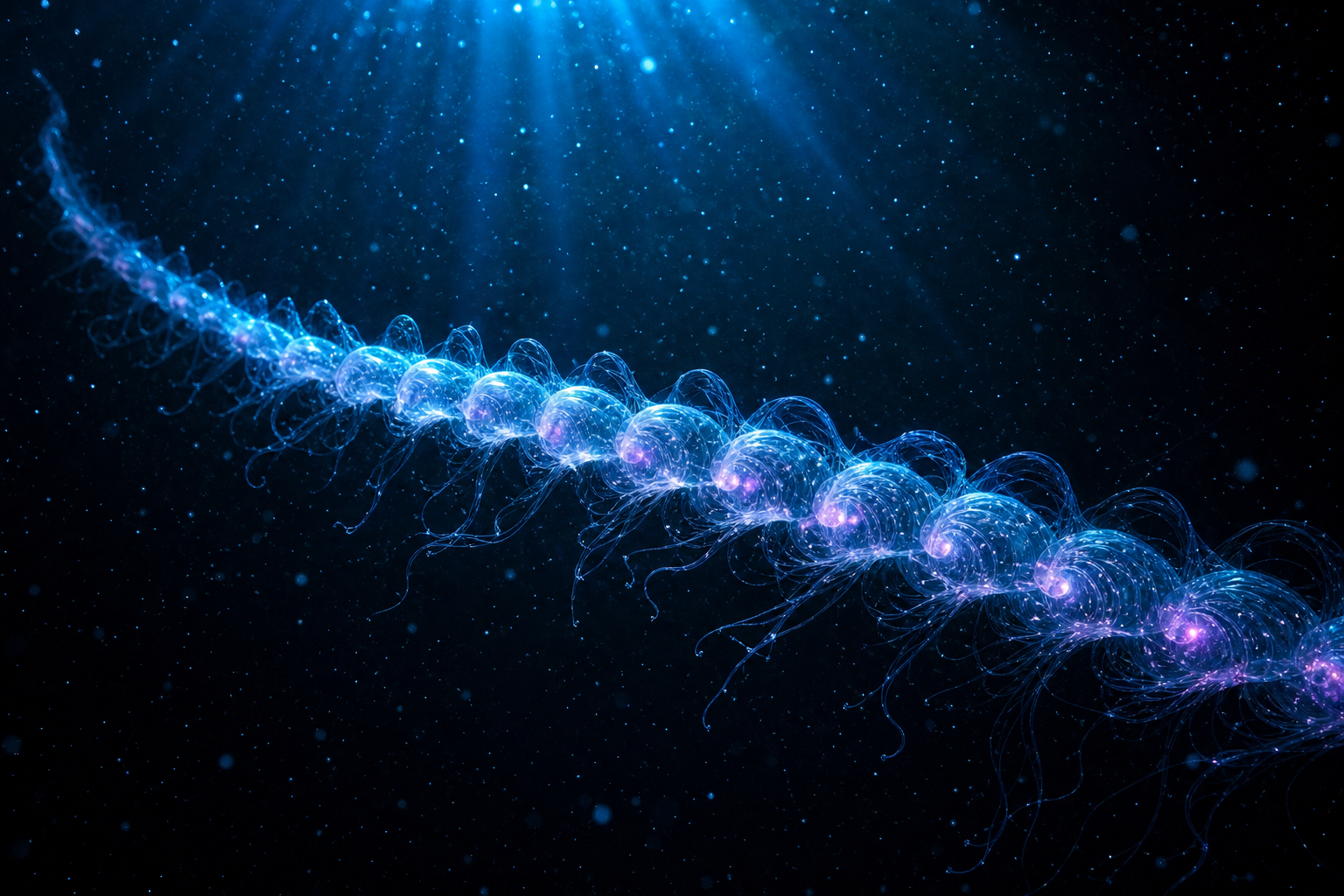
A long chain of glowing bioluminescent siphonophore colony orbs
PL. 04
N° 04 Erenna richardi

The Glowing Siphonophore

Habitat · 700–2,300 m · Mesopelagic

Not one animal, but thousands — a drifting colony of specialized zooids that cannot survive alone. Among its fishing tentacles hang tiny blue bioluminescent lures shaped, it is suspected, to mimic copepods. It fishes with forgeries of light. The colony may stretch forty metres, a single organism the length of a blue whale, drifting through the dark and blinking at its own private constellations.

MechanismZooid-specialized photophores
Wavelength460–490 nm
FunctionLure · colony signaling
IV

The deep speaks almost entirely in one colour.

Most organisms emit between 450–500 nm — the blue-green that seawater transmits best. Move the cursor across the band to read each frequency.

400450500550600650700 nm
488 nm · peak bioluminescence
Dragonfish · 705nm Anglerfish · 488nm Vampire squid · 470nm Siphonophore · 460nm
— FIN —

We came down to study the dark, and found it fluent.

— Field log, Station VII · 4,200 m